Is the Rolex GMT-Master II 'Pepsi' Being Discontinued?
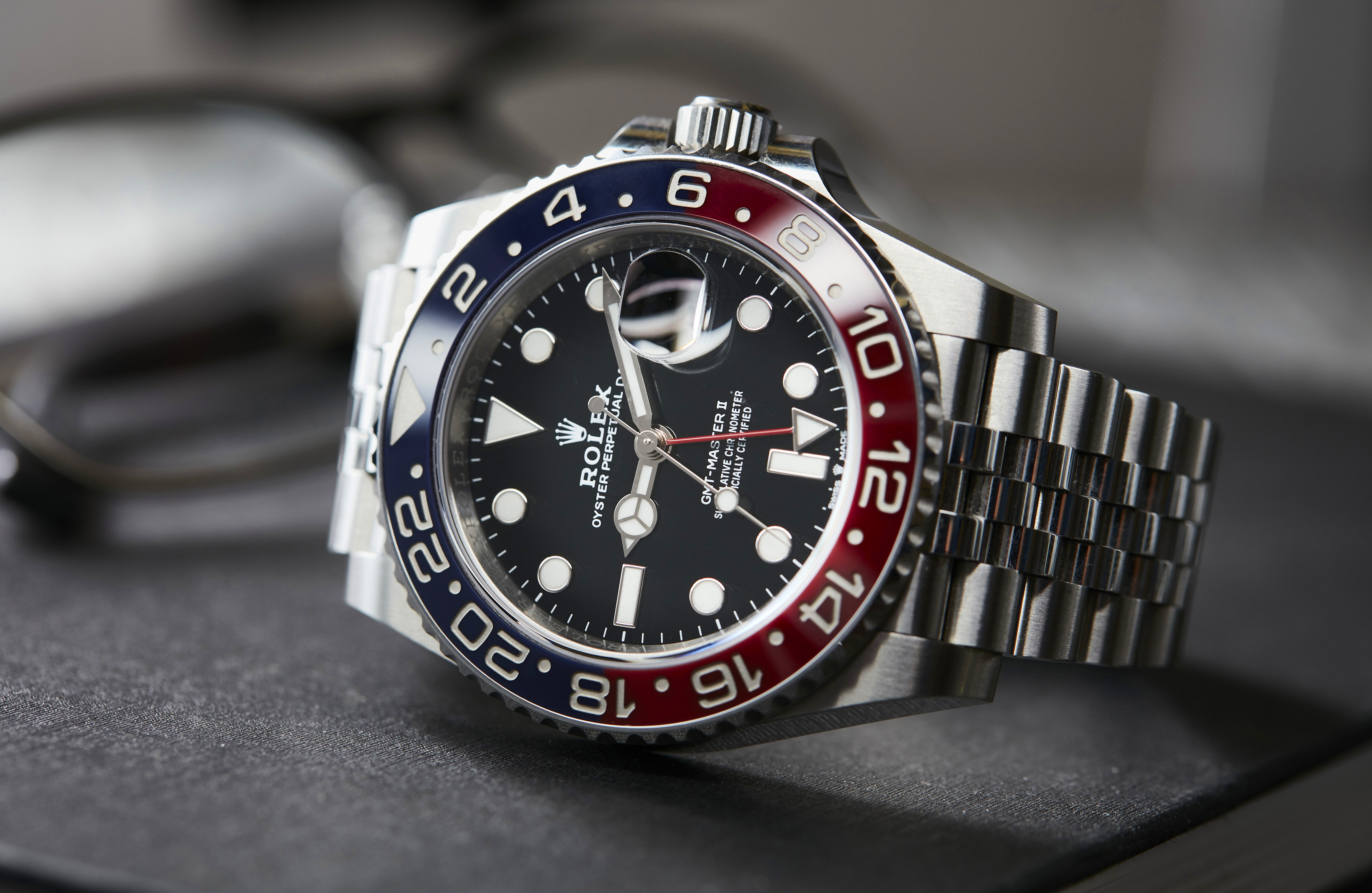
Reports of the Rolex GMT-Master II 126710BLRO 'Pepsi' being discontinued are persistent rumours within the collector community, but the model officially remains in the current Rolex catalogue. However, production challenges with its ceramic bezel fuel ongoing speculation.
Key Takeaways
- Persistent Rumours: For years, rumours have suggested the stainless steel 'Pepsi' would be discontinued due to difficulties in producing its iconic red and blue ceramic bezel.
- Ceramic Production Challenges: The patented process for creating a bi-colour ceramic bezel is complex, particularly in achieving a stable, rich red hue, leading to high rejection rates and limited supply.
- Historical Precedent: Rolex has a history of discontinuing popular models, often leading to a significant increase in their secondary market value, as seen with the Submariner 'Hulk'.
- Market Impact: The scarcity and speculation have already driven market values for the 126710BLRO far above its retail price. Official discontinuation would likely amplify this trend significantly.
The Enduring Legacy of the Rolex 'Pepsi'
The Rolex GMT-Master, with its signature red and blue bezel, is more than a watch; it is a horological icon. Born in the 1950s for Pan Am pilots, its design is instantly recognisable and deeply woven into the fabric of tool watch history. The latest stainless steel iteration, reference 126710BLRO, brought this legendary colourway to the modern era with a Cerachrom (ceramic) bezel. Yet, from the moment of its release, whispers of its demise have circulated. These are not baseless rumours, but speculation rooted in genuine manufacturing challenges.
A History Forged in Flight
To understand the 'Pepsi's' significance is to trace its lineage.
- Reference 6542 (1954): The original. Its bezel was made from Bakelite, a plastic prone to cracking and radioactivity concerns, quickly replaced by aluminium.
- Reference 1675 (1959-1980): A long-running and beloved reference that defined the GMT-Master for a generation. It introduced crown guards and cemented the 'Pepsi's' iconic status.
- Reference 16710 (1989-2007): The last of the aluminium bezel GMTs. A highly versatile watch, it was the end of an era and remains a collector favourite for its classic proportions and charm.
- Reference 116719BLRO (2014): The 'Pepsi' makes its ceramic debut, but exclusively in solid 18-carat white gold. This made it a prohibitively expensive, almost mythical, object for most collectors.
- Reference 126710BLRO (2018): The triumphant return to stainless steel. Offered initially on a Jubilee bracelet, it democratised the ceramic 'Pepsi' and created unprecedented demand that still vastly outstrips supply.
The Ceramic Conundrum
The speculation around the 126710BLRO’s discontinuation centres on one core issue: the difficulty of manufacturing its bi-colour ceramic bezel. Rolex’s patented process is an exercise in extreme precision and material science.
The bezel starts as a single piece of green, porous zirconium dioxide. The component is then saturated with a solution of metallic salts. This solution is selectively applied to one half of the bezel, which will become the blue portion. The entire piece is then fired (sintered) at over 1,600° Celsius, hardening the ceramic and shrinking it to its final dimensions. During this process, the metallic salts react and produce the final colour.
Why Red is a Fugitive Colour
Creating a stable, vibrant red pigment in a ceramic compound is notoriously difficult. The mineral pigments required are volatile at the extreme temperatures of the sintering process. Reports suggest Rolex faced, and perhaps still faces, a high rejection rate for its BLRO bezels. Early examples of the 126710BLRO often featured a slightly pink or purple-hued red, which collectors have categorised into 'Mark 1' and 'Mark 2' variations, before Rolex appeared to perfect a deeper, more stable crimson in later iterations. This struggle underpins the theory that Rolex may deem the model too inefficient to produce long-term.
Reading the Signs: Discontinuation Ahead?
Collector forums and authorised dealer networks are filled with anecdotal evidence. Some claim the model is "exhibition only." Others note that recent GMT-Master II releases, such as the new grey and black bezel reference 126710GRNR, signal a strategic shift away from the problematic BLRO.
Rolex operates with deliberate opacity, but its actions are telling. The company is not sentimental about its catalogue. It will discontinue a reference, no matter how popular, if it makes strategic or production sense. The discontinuation of the Submariner Date 116610LV 'Hulk' in favour of the 126610LV 'Starbucks' is a recent, powerful example. The 'Hulk', with its unique green dial and bezel, became an instant post-discontinuation phenomenon on the secondary market.
If the 'Pepsi' were to be discontinued, a similar, if not greater, market reaction could be expected. It is arguably the more iconic of the two, with a history stretching back over 60 years.
What a Discontinuation Would Mean
The effect on market value would be immediate and profound. The 126710BLRO already trades at a significant premium over its retail price. The finality of discontinuation would remove any hope of acquiring one at an authorised dealer, funnelling all demand to the secondary market. We would likely see a clear stratification in value between the early 'Mark 1' bezels and the later, more refined versions, as well as between the Jubilee and Oyster bracelet configurations.
For the collector, this presents a complex picture. For those who own one, it becomes an even more treasured possession. For those who aspire to own one, the dream moves further out of reach. It reinforces the nature of Rolex as an asset class as much as a horological passion.
Ultimately, whether the 126710BLRO is discontinued this year or remains in production for another decade, its place in watchmaking history is secure. The rumours only add to the mystique of a watch that has captivated collectors for generations. It remains the benchmark for all travel time watches – a true icon, in production or not.
Frequently asked
- Is the Rolex Pepsi being discontinued?
- As of 2024, the Rolex GMT-Master II 126710BLRO 'Pepsi' has not been officially discontinued and remains on the brand's website. However, persistent rumours and sourcing difficulties suggest it may be discontinued in the near future.
- Why is the Rolex Pepsi bezel so hard to make?
- The 'Pepsi' Cerachrom bezel is difficult to produce because a stable, consistent red pigment is notoriously hard to achieve in a ceramic compound at high temperatures. This leads to a high rejection rate during the patented manufacturing process.
- What is the reference number for the steel Rolex Pepsi?
- The reference for the modern, stainless steel Rolex GMT-Master II 'Pepsi' with a ceramic bezel is 126710BLRO.
- Will the Rolex Pepsi go up in value if discontinued?
- Based on historical precedent with other discontinued Rolex models like the 'Hulk' Submariner, it is highly likely that the secondary market value of the 126710BLRO would increase significantly upon discontinuation.
- What is the difference between a Rolex 'Pepsi' and a 'Batman'?
- Both are Rolex GMT-Master II models. The 'Pepsi' (BLRO) features a red and blue bezel, representing daytime and nighttime hours. The 'Batman' or 'Batgirl' (BLNR) features a black and blue bezel.